How many recently drafted law review articles are written with AI? A quick examination.
AI use in legal scholarship may not be the most important AI topic being discussed these days, but it is having a moment in the corners of the world that care about these things. Julian Nyarko has an interesting and timely post up at Reason (courtesy of Orin Kerr) asking "How Often are Articles In Top Law Reviews Written In Part By AI?" Matthew Sag has an interesting blog post on the topic of AI in legal scholarship, itself a summary and response to two longer pieces.
I appreciated Nyarko's empirical contribution, to give some data to these ongoing discussions. But I also wanted to know what the numbers would be with a slightly different methodology. In particular, I wondered what the numbers would look like if you look at article drafts posted to SSRN rather than published articles, and if you use Pangram 4 instead of Pangram 3.3.2.
I suspected the numbers might be different for two reasons. First, in another project, I have found Pangram 4 to be more sensitive to AI use while also maintaining Pangram 3.3.2's low false positive rate (Nyarko found Pangram 3.3.2 to have 0 false positives in his control sample, which was also my finding in another project). Second, law review articles are often published long after they are initially drafted—sometimes by a year or more, in my experience. SSRN, in contrast, is a place where people post their drafts before they are accepted for publication, or shortly after that acceptance but before the months-long editing process that precedes publication. So, in principle, law review article drafts posted on SSRN should give us a more updated sense of where people's writing currently is.
So I whipped together a quick examination of law review drafts that have been posted on SSRN, and ran them through Pangram 4. Like Nyarko, I used an agentic AI tool to help with this: I had Claude Code identify and pull as many law review articles as it could find from the Legal Scholarship Network on SSRN that had been posted from April 1, 2026, onward, and that did not appear to have been written earlier than that (e.g., not including articles written in 2024 but just posted recently—it checked to make sure there were recent citations, for instance).
To narrow the scope of the inquiry, I considered only solo-authored articles, and had Claude confirm via publicly listed faculty pages that each author was a faculty member at a U.S. law school (counting doctrinal faculty, clinical faculty, and legal writing faculty, but not people identified solely as lecturers, adjuncts, fellows, or visitors). That resulted in about 700 PDF drafts. I conducted periodic spot checks throughout, confirming that these "look like" draft law review articles, to me at least, and that they are written by faculty members at U.S. law schools.
It would be expensive to run that number of articles through Pangram 4—it's $.05 per 100 words of input, and law review articles are not known for being short. So to cut costs down, I had Claude select a random sample of 200 articles from that set. I also had Claude extract only the above-the-line text to analyze, leaving footnotes out of it. So the results here are only from these articles' main text, not footnotes.
Pangram gives you data in a few different ways. Nyarko's approach, which I think is good, focuses on two things: (1) how many papers have any "AI signal," combining Pangram's "AI written" and "AI assisted" designations; and (2) how many papers have more than 5% of their text assessed by Pangram as AI written or AI-assisted.
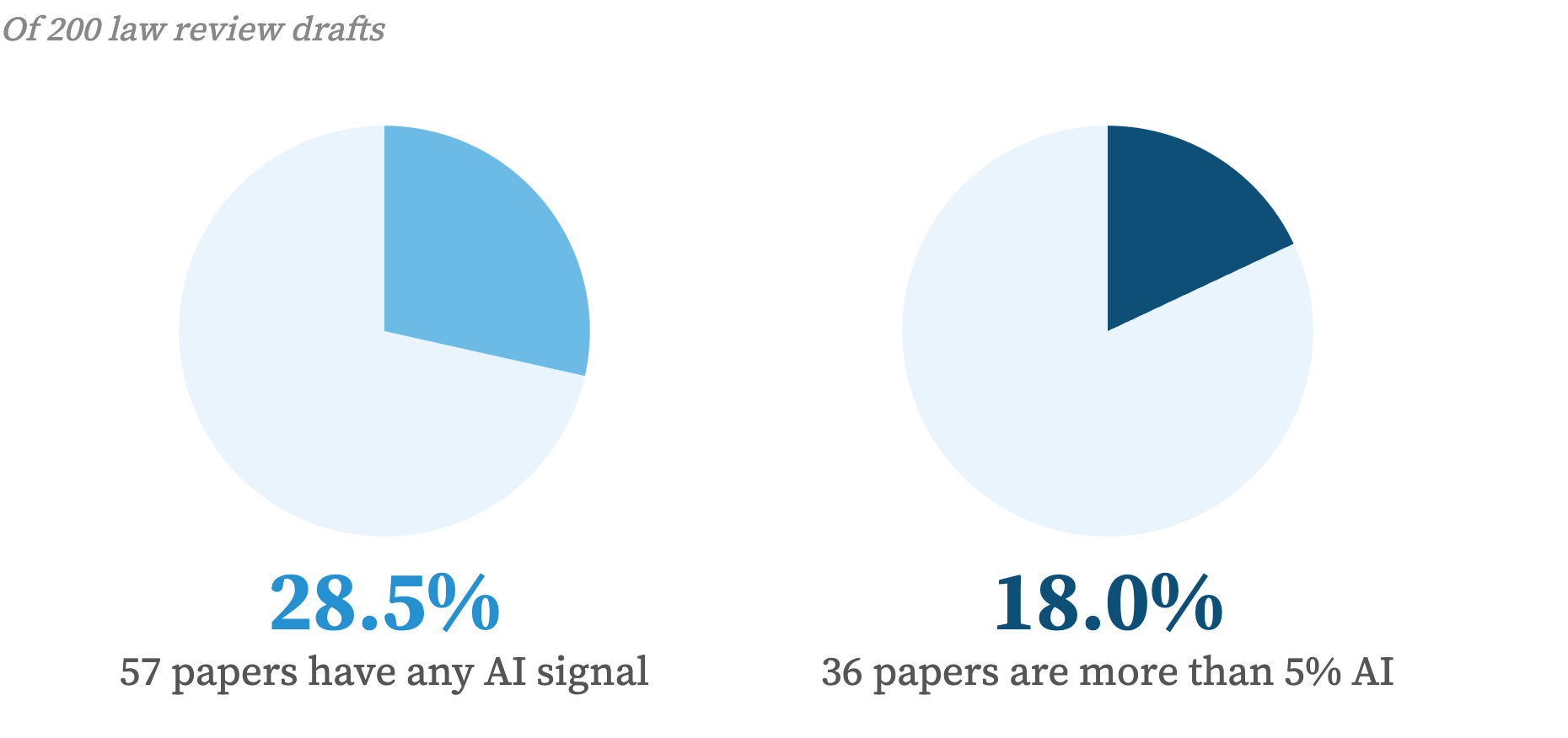
In my sample of 200 draft law review articles posted on SSRN between April and August of 2026, I found that 28.5% (57 papers) had a positive AI signal—at least some text flagged by Pangram as written with or assisted by AI. Pangram also estimated that 18% (36 papers) had more than 5% of their text generated by AI.
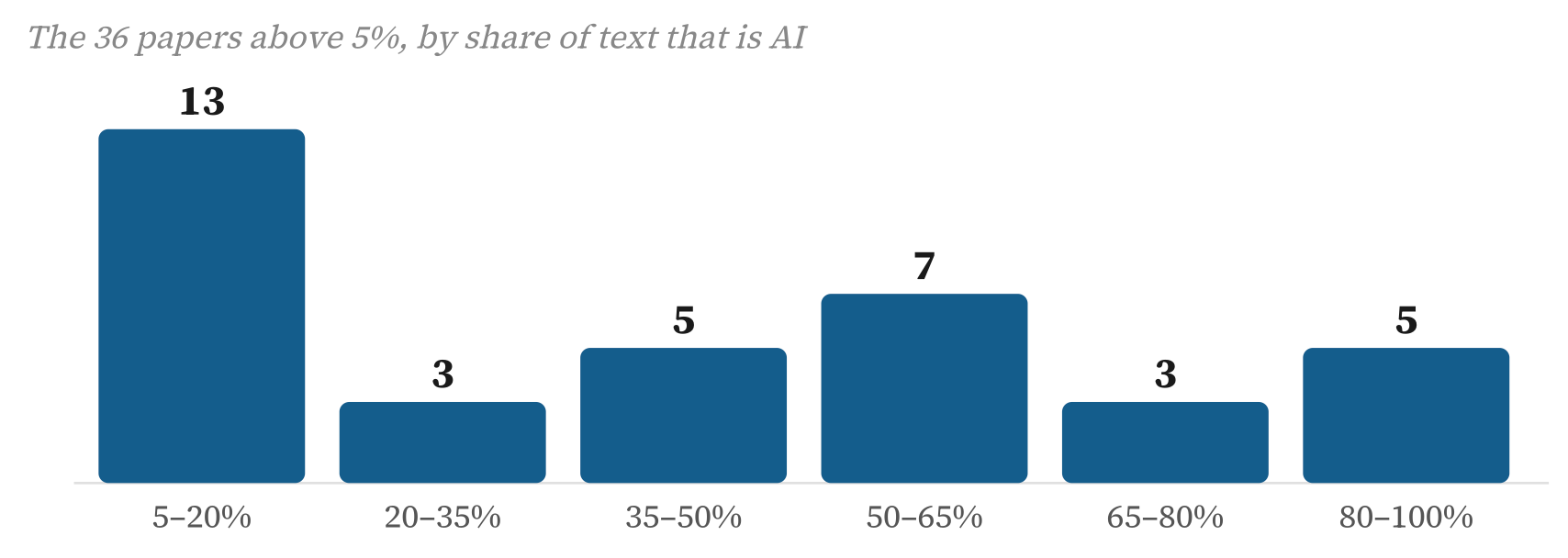
Here's a histogram breaking down those 36 papers by what fraction of their text Pangram labeled as AI-generated:
Here's how the data from this set of papers compares with Nyarko's data from published law review articles:
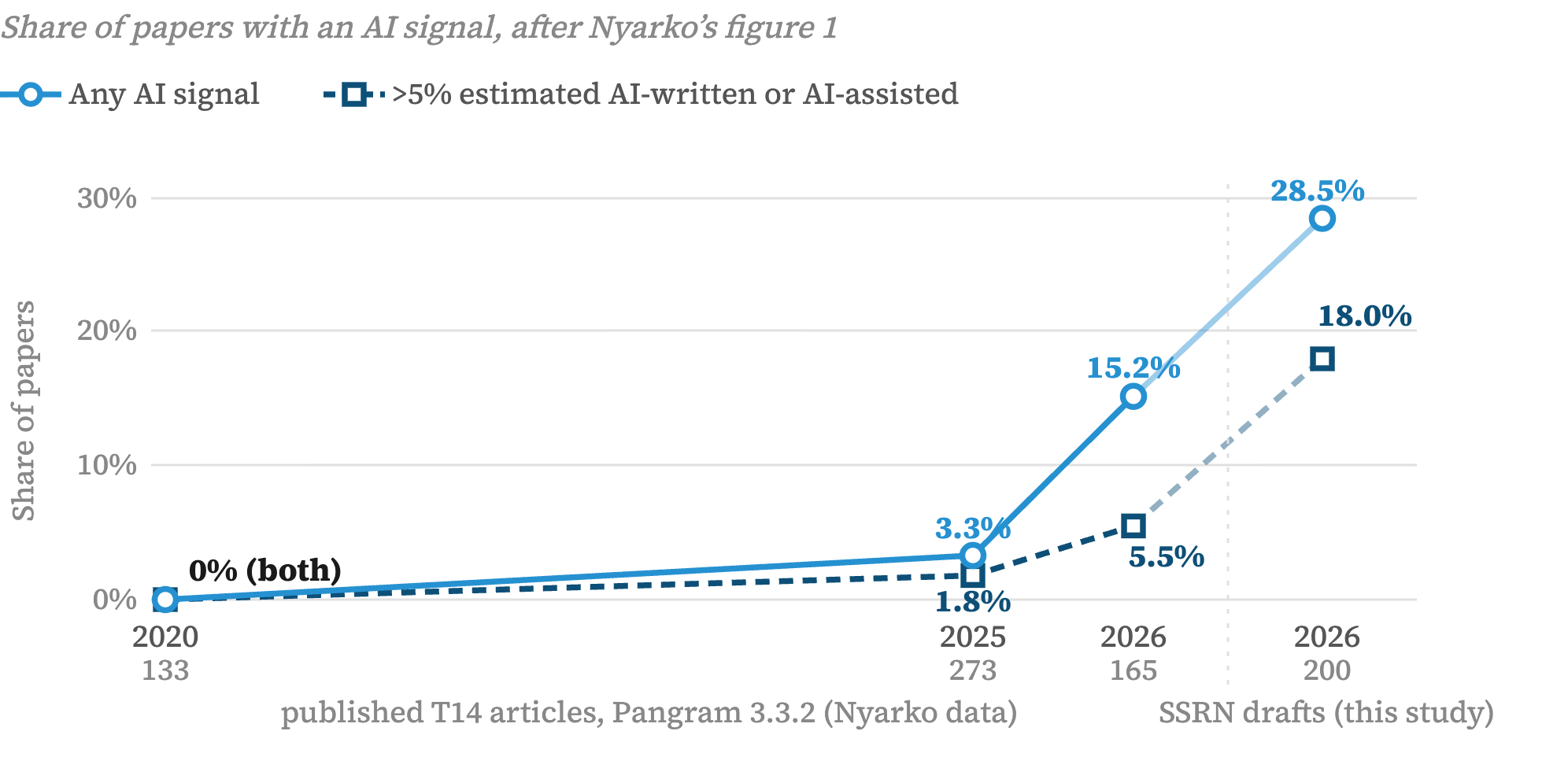
The data I'm adding here could reflect a few things. The most likely story, in my mind, is that AI use in law review article drafting is going up. But Nyarko's data just reports on published articles in the T14. So it may be that articles using AI are less likely to get accepted for publication at all, or less likely to get accepted for publication in the T14—and so pulling pre-publication drafts from SSRN would show a higher AI signal even if the change over time in AI use is flat.
I'm not going to weigh in on the normative side here, in part because I'm still figuring out what I think about all of this. But part of the process of collectively figuring this out is getting more information about what "this" is. Hopefully these kinds of brief studies add a little point-in-time detail to ongoing conversations.